
Fast Wired vs Wireless Charging in Oman: 4 Brutal Truths That Will Change How You Charge

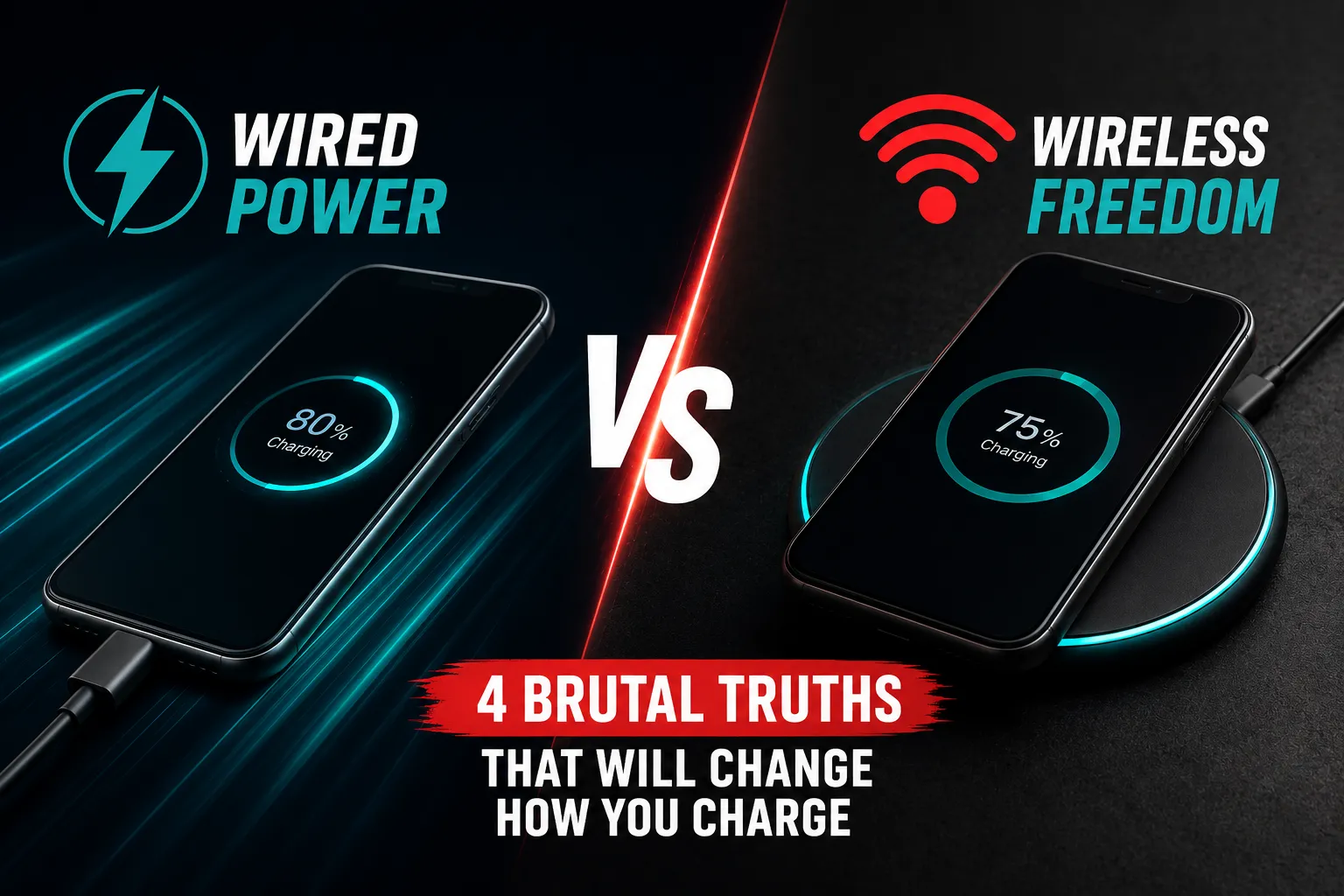
Fast wired vs wireless charging in Oman is not just a speed debate; it is a decision that needs to account for Oman’s climate, your phone’s actual supported wattage, and what you are actually paying for when you spend 15 to 35 OMR on a wireless charging pad. If you just got a phone that supports wireless charging and someone told you to buy a wireless charger, pause before spending the money. Here are the four truths nobody tells you before you buy.
TL;DR: Wired fast charging is 2–4x faster than wireless in real conditions, costs less per unit, and performs more reliably in Oman’s heat. Wireless charging earns its place at a desk or nightstand for convenience, not speed. Buy both only if your budget allows it — otherwise buy a quality GaN fast charger first and add wireless charging as an upgrade later.
| Factor | Fast Wired Charging | Wireless Charging (Qi2/MagSafe) |
|---|---|---|
| Speed (0 to 50% battery) | 20–35 minutes at 20W+ | 45–90 minutes at 15W Qi2 |
| Heat generated | Moderate — conversion happens in the brick | Higher — conversion happens inside your phone |
| Performance in the Oman heat | Consistent | Degrades above 35°C ambient temperature |
| Price in Oman | 5–20 OMR for a quality GaN charger | 15–40 OMR for a Qi2 pad |
| Works with laptops | Yes — USB-C PD up to 240W | No — no wireless standard charges laptops |
| Best use case | Emergency top-ups, travel, laptop charging | Desk, nightstand, daily convenience |
For most buyers in Oman, a quality 65W GaN wired charger at 12–18 OMR from Anker or Baseus delivers more practical value than a wireless charging pad at the same price. Add wireless charging when you want the desk or nightstand convenience — not as a replacement for wired.
The 4 Brutal Truths About Fast Wired Vs Wireless Charging in Oman
Truth 1: Wired fast charging is 2–4x faster than wireless — and the gap matters here.
In independent real-world tests, a 20W wired charger takes a typical phone from 0 to 50% in 25–35 minutes. A Qi2 15W wireless pad takes 45–90 minutes for the same result. In Oman, where people regularly leave the house and need to charge quickly before an errand or a meeting, that 30 to 60-minute difference is real and daily. If you have overnight charging covered, wireless is fine for the nightstand. If you are regularly charging under time pressure, wired is what you actually need.
Truth 2: Wireless charging generates more heat inside your phone — and Oman’s climate makes that worse.
Wireless charging via electromagnetic induction loses 30–40% of transferred energy as heat, and that heat is generated inside your phone rather than in the charger brick. In a room at 20 degrees, this is manageable — modern phones throttle wireless charging when they get too warm. In a room at 35 to 40 degrees without air conditioning, or a car charging mount in Muscat’s summer, your phone hits its thermal limit faster, and wireless charging slows to a trickle or pauses entirely to protect the battery. This is not a fault — it is physics. But it means wireless charging in Oman’s ambient conditions performs less reliably than the spec sheet suggests.
Truth 3: You might be paying for fast charging wattage your phone doesn’t support.
A common mistake in Oman’s accessories market is buying a 65W or 100W GaN charger for a phone that only accepts 20 or 25W maximum input. The charger will work — it detects your phone’s limit and adjusts — but you’re paying for 65W of output that delivers 20W in practice. Before buying any fast charger, check your phone’s maximum supported charging wattage in its specifications. Match your charger to that figure rather than buying the highest number available.
Truth 4: Wireless charging cannot charge your laptop — wired can.
If you own a laptop that charges via USB-C (which most modern laptops do), a single quality 65W GaN wired charger handles your phone, tablet, and laptop from one plug. No wireless charging pad can do this; there is no wireless standard that charges laptops in 2026. If you are trying to reduce the number of chargers you travel with or carry between home and work, a 65W GaN wired charger is the single most versatile accessory you can buy.
Which Wireless Chargers Are Worth Buying in Oman If You Do Want One?
Qi2-certified pads are the only wireless chargers worth buying in Oman right now. The Qi2 standard’s magnetic alignment means your phone charges at the pad’s maximum rate every time, rather than misaligning and dropping to half speed. Anker MagGo pads are the most reliably stocked Qi2 option in Muscat. Avoid older Qi 5W or 7.5W pads; at those speeds, the convenience argument over a cable disappears entirely.
For current stock on GaN fast chargers, wireless pads, and USB-C cables across all speed tiers, browse mobile and tablet accessories at Sky Gadgets across all four Muscat branches. For a full picture of what accessories make sense for your specific phone and daily use pattern, our complete mobile and tablet accessories in Oman buying guide covers the full decision. For independent real-world speed testing data across all major charging standards, Anker’s official GaN technology explanation is the clearest manufacturer-level breakdown available.
Frequently Asked Questions
Is wireless charging worth it in Oman’s heat?
For overnight or desk charging in an air-conditioned room, yes — wireless charging is genuinely convenient and works reliably. For charging in a hot car, a room without AC, or any situation where you need speed, wired is the better choice. Oman’s ambient temperatures cause wireless charging to throttle more frequently than in cooler climates because the additional heat from induction compounds the existing ambient heat.
What is the best fast charger to buy in Oman?
An Anker 65W GaN charger at 12–18 OMR from Microless or Gadgets Oman is the most versatile option available locally. It fast-charges any phone that supports up to 65W, handles most laptops via USB-C PD, and is compact enough for daily carry. Match the wattage to your phone’s maximum supported input rather than buying the highest wattage available.
Does fast charging damage your phone battery?
Modern fast charging is designed to deliver high speed only in the first 50% of a charge cycle, then slow down deliberately to protect the battery. A quality certified fast charger from Anker, Samsung, or Baseus does not meaningfully accelerate battery degradation compared to standard charging. Fake or uncertified chargers that claim fast charging but deliver inconsistent voltage are the actual risk of battery damage.
Can I use a wireless charger in my car in Oman?
Yes, but with realistic expectations. A car mount wireless charger in Muscat’s summer will frequently throttle or pause charging because the phone’s temperature limit is reached quickly between the ambient car heat and the heat from wireless induction. A cable charger in the same car mount scenario charges faster and more consistently. If you use a wireless car mount, make sure the phone is out of direct sunlight and the AC is running.